The Washington Post Scales Expressive Motion to Make Digital News Feel Human

Emma Kumer - Senior Newsroom Designer, TJ Gioconda - Principal Product Designer
About The Washington Post
The Washington Post, regarded as one of the leading news sources in America, publishes stories daily on its website and app, for its print newspaper and on social media accounts. Founded in 1877, The Post has been recognized with more than 75 Pulitzer Prizes.
Summary & Key ROI (At-a-Glance)
The Washington Post uses Lottie to bring expressive, high-performance motion into one of the most demanding digital publishing environments. By replacing heavy GIFs and video-based animations with lightweight Lottie files, the team dramatically reduced file sizes while expanding creative freedom across interactive articles, UI elements, and reader reactions.
Key ROI Highlights
More than 80% reduction in animation file sizes
Faster load times across high-traffic pages
Greater creative flexibility without engineering overhead
Increased reader engagement through interactive motion
The Idea: Bringing Expressive Motion to a Performance-Critical News Platform
The Washington Post uses Lottie in many different ways. Most recently, we have created an animated set of emojis for readers to use to react in our comment section. Each emoji animates when clicked or hovered, which leads to a more immersive and dynamic experience. Because these animations appear in so many places on the page, it is important for them to be incredibly small files!
We also use Lottie in many of our interactive article pages. We’ve used it to create overlays for maps, add moths in flight, depict nuclear weapons in space, recreate game overlays from The Sims, and optimize animated typography.
Many of our designers are already familiar with After Effects, so the LottieFiles After Effects plug-in allows us to convert those skills directly into web design without having to know how to build the same motion in javascript.
The Lottie component makes it easy for us to use these elements within our coding template, the same way we would any of our native components.
Results: Smaller Files, Faster Loads & Greater Creative Freedom
Before using Lottie, hosting animations on our website would require uploading a .mp4 video or .gif. To keep load time optimized, these files were restricted to be less than 2 MB, which led to a difficult export process that often reduced the quality or complexity of the art.
With Lottie, the same 2 MB gif file can be converted to a 385 KB .json file — half the size of most of our static images!
Tips for Design Teams
Keep your anchor points minimal. The key to a great animation starts with a clean illustrator file.
Don’t scale back any ideas. Lottie technology has improved a ton even in the time we’ve been using it — almost anything you can do in After Effects will translate, as long as you’re willing to play around with the file and layer order!
For the coders… get familiar with Lottie react props!
Double-check your colors. When you’re working like a specific color palette like we are, sometimes the specific shades get shifted during vector conversion.
This tool is more than just AE > JSON conversion. Want to edit an animation that another designer created — but you don’t have their After Effects file? No problem. LottieFiles lets you import a .json file back into After Effects so that you can make tweaks and re-export.
What the Team Learned About Designing Motion at Scale
Staff Product Designer, TJ Gioconda, stated that Lottie gave the team more creative freedom to add personality such as subtle movements that bring delight without being distracting or over-designed. For example, the laughing emoji doesn't just sit there; it bounces with actual emotion.
“These little moments make commenting feel less transactional and more human.
The challenge was designing emojis that could work at scale in a space where performance has a massive impact on the experience. Video or GIFs could've killed our load times or forced us to strip out the expressive details that make emojis feel alive.
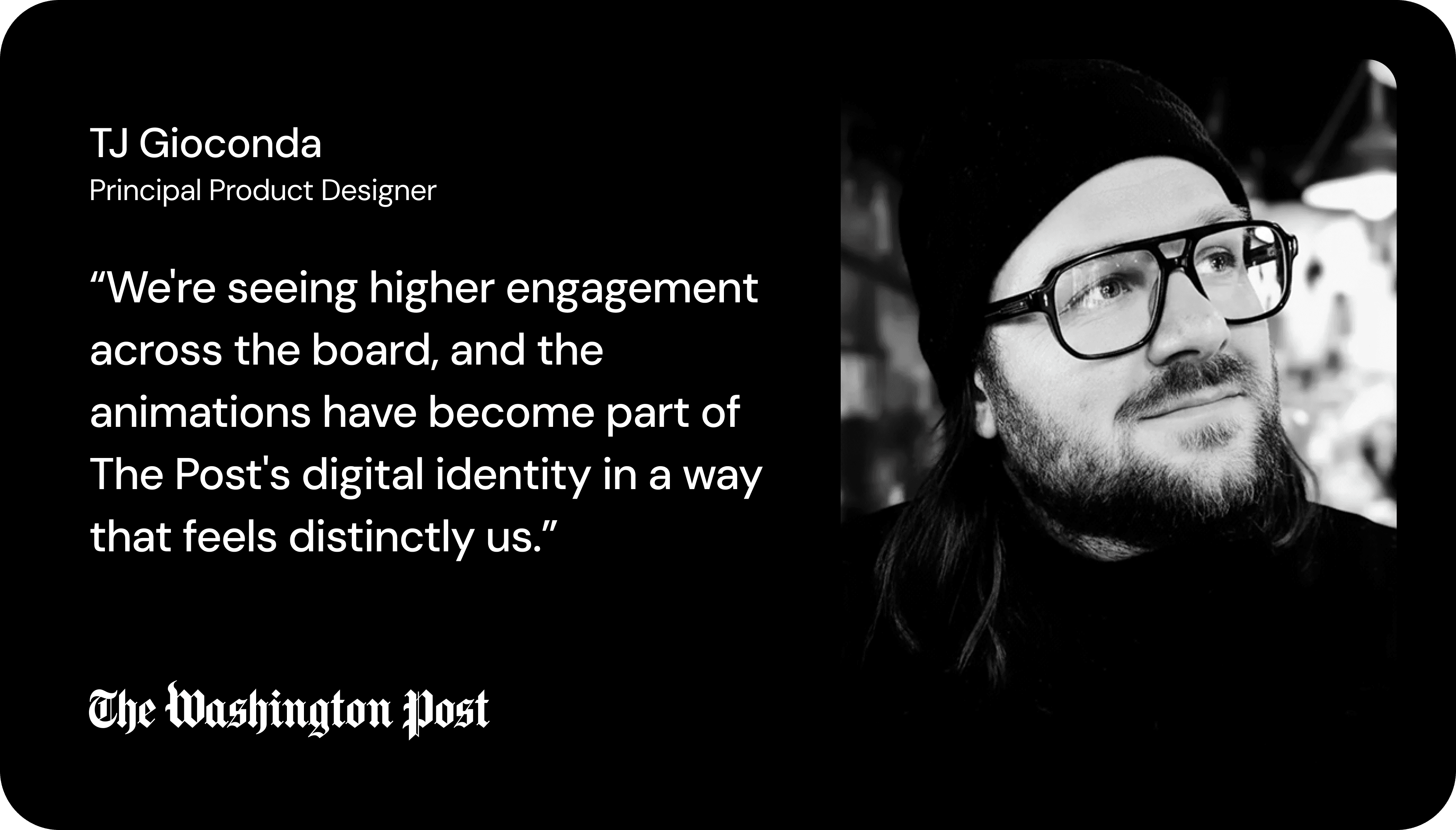
The response has been great. We're seeing higher engagement across the board, and the animations have become part of The Post's digital identity in a way that feels distinctly us,” said TJ.