
Motion Is the One Discipline You Can Feel but Can’t Measure

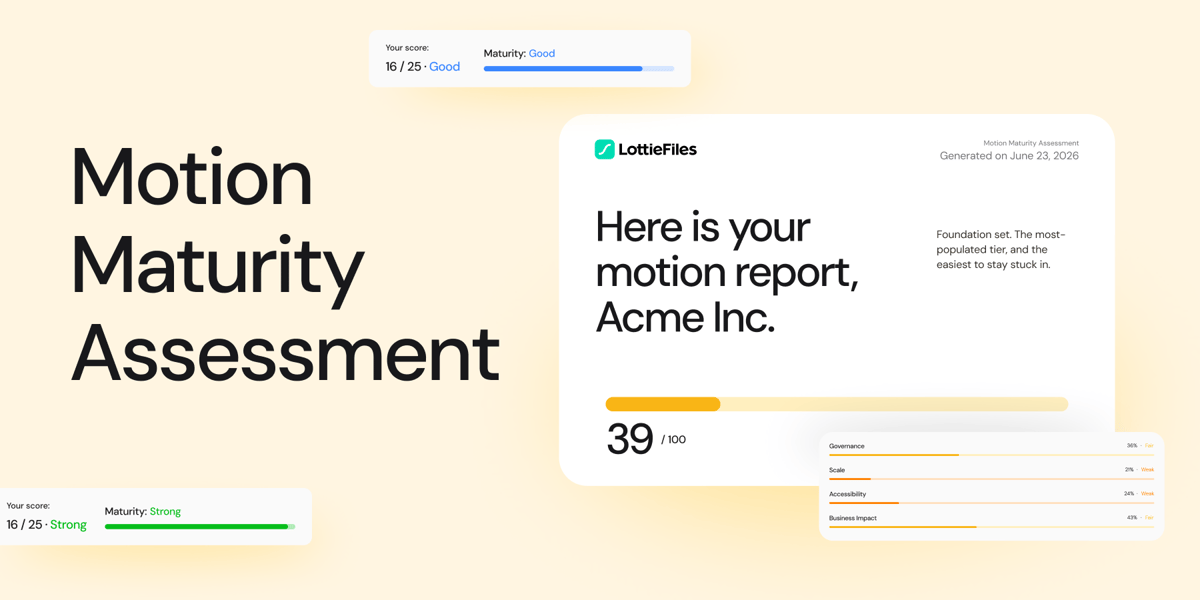
Who owns motion on your team? For most teams the honest answer is a shrug. That is the gap worth looking at.
In short: motion is the only part of your design system without an owner or a scorecard, which is exactly why it is so hard to fund. The Motion Maturity Assessment is a free, three-minute check that scores your team across four pillars (governance, scale, accessibility, and business impact), places you in one of four maturity tiers, and returns a personalized, forwardable report on the first gap to fix.
Here is a question that tends to make a design review go quiet: who owns motion on your team?
You can probably answer it for everything else. Someone owns color. Someone owns type. Someone owns the component library. Ask about motion and you usually get a pause, a Slack thread, and whoever had a free afternoon before the deadline. That is not a knock on your team. It is true almost everywhere, and it is worth being honest about.
Which puts motion in a genuinely strange spot. It is all over your product, it shapes how the whole thing feels, and it is often the last thing anyone touches before a launch. Yet if someone asked you today how good your team actually is at it, whether you are ahead of your peers or behind, you would not have a number. You would have a hunch. And a hunch is a hard thing to build a case on.
Motion stopped being a finishing touch
Motion used to be the polish you added at the end if there was time. That is not where it lives anymore. It carries meaning in onboarding, it guides attention in complex flows, it signals state, and it does real work for conversion and comprehension. Teams that treat it as a system are pulling ahead of teams that treat it as decoration.
The market is telling the same story. Only 26% to 37% of creative professionals say they feel very prepared for where the market is heading. Demand for motion content is growing anywhere from five to twenty times. And the field is splitting in two: the basic, repetitive work is getting automated, while teams that think about motion as a system are the ones commanding the budget and the headcount.
So the pressure is real, and it is rising. The problem is that most teams cannot see their own position in it.
Why "we can't measure it" is the actual problem
Here is the pattern we hear from design and motion leads over and over. They can feel that their motion is messy and one-off. They know it is slowing them down and holding the work back. But they cannot put a number on it. And if you cannot measure something, you cannot fund it.
That is the quiet cost. Motion never gets an owner, a budget, or a dedicated hire, because every case for it turns into a gut-feel argument in a room full of people who want data. The person making the case loses, not because they are wrong, but because they have nothing to point at.
This is why measuring motion maturity matters. Not as a vanity score, but as the thing that finally turns a feeling into evidence you can take to the people who hold the budget.
What "motion maturity" actually means
Motion maturity is simply how far your team has moved from doing motion as a series of one-offs toward running it as a system. We look at it across four pillars.
Governance. Who owns motion, where it lives, and whether there is a shared standard, or whether every designer is starting from scratch and hoping it matches.
Scale. Whether your motion holds up across surfaces, platforms, and file sizes, or whether it breaks, bloats, and gets rebuilt every time it moves.
Accessibility. Whether you handle motion sensitivity and reduced-motion needs deliberately, or leave it to chance.
Business impact. Whether motion is tied to outcomes the business cares about, or floats disconnected from anything you can report on.
Across those four pillars, a team lands in one of four tiers: Starting, Building, Formalizing, or Leading. The point of the tiers is not to rank you against a named company. It is to show you what a team that has nailed governance, or scale, or impact, actually looks like, using real examples from teams like Robinhood, Washington Post, and Uber, so you can see the shape of the next step rather than a scary gap.
How the motion maturity assessment works: 3 minutes, 11 questions
We built the Motion Maturity Assessment to be the first mirror for this. It is a short quiz, about three minutes, and it is free.
You answer eleven questions about how your team actually handles motion today. Not aspirations, not what the deck says, what really happens. From your answers we compute your maturity stage and your score across the four pillars, and we identify the first gap worth fixing.
There is no pitch. The assessment is about giving you useful insights, not selling you a product. Enter your work email, and you will receive a personalized report as both a link and a PDF.
What is in the report, and what to do with it
The report is built around you and your answers. It gives you:
- Your maturity tier, from Starting to Leading, and your score across Governance, Scale, Accessibility, and Business Impact.
- Your strengths and your gaps, named specifically, based on what your team already does.
- The top three moves to fix first, so you leave with a short roadmap rather than a long list of problems.
- Real examples from teams at your stage, framed as what "good" looks like next, not as a benchmark you are failing.
And here is the part that matters most. The report is forwardable. It is written so you can send it to the person who holds the budget and let it make the argument for you. For a long time, the case for motion has been a gut-feel argument that practitioners lose. This turns it into a document with a score, a tier, and a clear first step, from the team that knows this category best.
So the "what next" is straightforward. Take it. Read where you land. Then forward it to the person whose sign-off you need, and use it to start the conversation you have not been able to start before.
Find out where your motion practice stands
You already have a feeling about how your team handles motion. In about three minutes, you can turn that feeling into a number, a tier, and a first move.
Start the 3-minute check. No pitch, just the report.
Frequently asked questions
What is motion maturity?
Motion maturity is how far a team has moved from treating motion as a series of one-offs toward running it as a governed system. It is measured across four pillars: governance, scale, accessibility, and business impact.
What is the Motion Maturity Assessment?
It is a free, three-minute check from LottieFiles that scores your team's motion practice, places you in one of four maturity tiers, and returns a personalized report on where you stand and what to fix first.
How long does it take, and is it free?
About three minutes, and yes, it is free. There is no pitch. You answer 11 questions, 10 to complete and 1 optional question, about how your team handles motion today.
What does the report include?
Your maturity tier from Starting to Leading, your score across the four pillars, your specific strengths and gaps, the top three moves to fix first, and real examples from teams at your stage. It arrives by email as a link and a PDF.
Can I share the report with my team?
Yes. The report is built to be forwarded, so you can send it to whoever holds the budget and let it make the case for investing in motion.
Is this a LottieFiles product pitch?
No. The assessment gives you the report, not a sales call. It is a way to measure your motion practice, scored by the team that knows the category best.
You may also like

Making the Business Case for Motion: What the Numbers Actually Mean
There's a version of this conversation that starts with convincing you motion is important. This isn't that conversation.

Best Motion Design Tools in 2026: Ranked by Use Case
The right motion design tool in 2026 is determined by one question: where does the animation live?
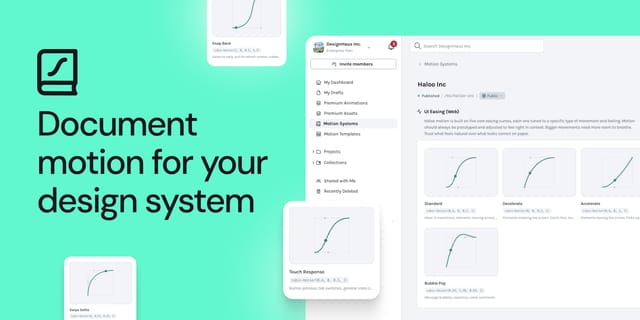
How to Document Motion in Your Design System: A Step-by-Step Guide
Here's how to actually document motion in your design system, step by step.
Create with Motion: The Complete Guide to Shipping Motion That Actually Scales
Every other layer of your product stack has been standardized. Color, typography, spacing, components. Motion hasn't. Here's how to fix that.