
Making the Business Case for Motion: What the Numbers Actually Mean


There's a version of this conversation that starts with convincing you motion is important. This isn't that conversation.
By the time a design organization reaches a certain scale, motion has already made the decision for you:
- It's in the onboarding flow your mobile team shipped last quarter.
- It's in the loading states your platform team is maintaining across three separate codebases.
- It's in the animated hero your brand team commissioned from a contractor six months ago, whose source file nobody can find.
Motion is already everywhere in your product. The problem isn't that you haven't invested in it and that nobody owns it.
That's the real framing for what follows. The decision your team is being asked to make isn't "should we invest in motion?" The answer is already embedded in your product stack. The decision is whether to govern what already exists, or to keep absorbing the cost of running it informally.
The informal tax has a number & it's not small
Most design organizations don't think of their animation workflow as having a tax. They think of it as just how things work. But when you actually map the steps, the cost becomes hard to ignore.
A typical ungoverned animation cycle runs like this: build the asset in After Effects, export it as a video file, convert that video to a GIF in Photoshop, optimize it by hand, pass it to engineering, discover it looks wrong on mobile, fix it, and start again. This happens almost too often with every single animation.
Tazapay, a cross-border payments company, ran this exact workflow until they sat down and looked at what it was actually costing them in time.
What governance changed at Tazapay
Before LottieFiles, a single animation took weeks to produce from concept to production. After integrating LottieFiles into their workflow, it took 3 to 4 days.
In their own words: "After including LottieFiles in our workflow, the time spent on animating and testing has been reduced between 3 to 4 days."
For a team shipping 20 animations per quarter, that compression is significant:
- What took weeks now takes 3 to 4 days per animation cycle
- Revisions that previously required re-exporting through multiple tools are handled directly in LottieFiles
- The design-to-engineering handoff, previously a multi-step process involving video exports, GIF conversions, and mobile fixes, collapses into a single lightweight file
The informal tax is real. It just rarely gets measured until someone decides to.
What motion actually moves when it's working
Production efficiency is one half of the business case. The other half is revenue, and that's where the conversation with your Chief Financial Officer (CFO) starts.
The instinct in most organizations is to treat motion as a quality-of-life improvement. They think: nicer animations, more polished product, better brand perception. These things are true, but they undersell what's actually happening when motion is implemented well.
Motion is an attention mechanism; it captures focus in a feed of static content. In an onboarding flow, it shows users what to do instead of asking them to read it. In a conversion surface, it changes behavior in ways that pure copy rarely can.
The conversion case: ET Money
ET Money, a personal finance platform operating in one of the most competitive and trust-sensitive categories in digital products, replaced their static home screen banners and onboarding visuals with Lottie animations. The results weren't marginal.
- Click-through rates (CTR) moved from 2 to 3% up to 8 to 9%, peaking at 11%
- That's a 450%+ lift in CTR, from the same impression count
- Production time dropped 40% after centralising their animation workflow on LottieFiles
When you model that CTR lift against your existing impression volume, it becomes a revenue number very quickly. If your product has a home screen, an onboarding flow, or any moment where you're asking a user to take action, there is now documented evidence of what governed motion does to that conversion rate.
The infrastructure argument your engineering team will care about
The conversation so far has been about designers and conversion. But there's a third stakeholder in every enterprise motion decision, and that's the engineering and infrastructure team. For them, the argument looks different, and at scale, it can be even more compelling.
The format your animations live in is not a design choice. It's an infrastructure choice. File size affects CDN costs. Load time affects Core Web Vitals. Memory usage affects performance on the low-spec devices that a significant portion of your users are actually running. At a certain scale, these are P&L variables, not UX variables.
What happened at Gojek
Gojek runs more than 20 products inside a single super-app serving tens of millions of users across Southeast Asia. When they audited their animation format choices, the problem was operational: heavy files were creating bandwidth strain and memory pressure across a user base running a wide range of devices in markets where a slow load is often a lost user.
After migrating to dotLottie:
- Animation files shrank by up to 89.35% compared to Lottie JSON
- Memory fluctuation dropped by 99.6%
- App performance improved measurably across all device tiers
A note on formats that matters for procurement
Lottie JSON was already a significant step forward from GIFs and video exports: vector-based, resolution-independent, and far lighter than raster formats. For most teams, it's a solid foundation that delivers real performance gains.
dotLottie is the next step: it compresses the JSON and bundles all assets into a single binary file, making it roughly 90% smaller than Lottie JSON. It's not a replacement. It's a performance upgrade you reach for when you're optimizing at Gojek's scale.
What this decision looks like at the organizations that have already made it
What's striking, when you look across the organizations that have formalized motion governance, is how similar the reasoning is regardless of industry, company size, or the specific problem they started with. The surface details vary. The underlying logic doesn't.
These aren't early adopters. They're some of the most operationally sophisticated product organisations in the world, and they all arrived at the same conclusion: motion at scale needs a governance layer, and the cost of not having one eventually becomes impossible to absorb.
Robinhood
Robinhood's visual language relies on complex shape layers, gradients, and illustrative elements that engineering simply couldn't replicate in CSS or JavaScript. The alternative was months of development time per feature, and that was before accounting for what broke at the handoff. Lottie closed that gap entirely and gave their motion team a direct path to production that didn't route through a months-long engineering queue.
The outcomes went beyond workflow efficiency:
- Animated loaders replaced static support screens and measurably reduced perceived wait time
- Onboarding flows created what their team calls "screenshotable moments" that drive brand recall and engagement
- Product and brand became visually coherent in a way that hadn't been possible before
"Lottie really genuinely allowed us to kind of connect them [product and brand] in a much stronger and more cohesive way," said Azeem Segrave, In-Product Motion, Robinhood
Headspace
For Headspace, the problem wasn't capability. It was consistency. They needed motion across every surface of their product, from in-app UI to browser-based elements to ambient meditation backgrounds, and other formats kept introducing the same set of problems: compression artefacts, responsive scaling issues, and rendering inconsistencies that meant what they designed was never quite what shipped.
Lottie gave them colour-accurate, resolution-independent animation with consistent rendering across all surfaces, at file sizes that didn't create implementation trade-offs.
"Knowing I have this capability allows me to deepen otherwise static graphics into moments of joy and mindful engagement. These injections of delight can be cumbersome in other formats, since file size, rendering speed, and ease of implementation factor heavily into whether features and animations make it into the app," said Brian Lee, Lead Animator, Headspace.
Instacart
Instacart's motion challenge was a cross-platform problem at volume. Before Lottie, shipping one animation meant building and maintaining separate files for web, mobile, iOS, and Android. GIFs broke the moment transparency was involved. PNG sequences weren't viable at their output volume. Every format had a ceiling, and they kept hitting it.
Lottie collapsed the entire multi-file workflow into one asset, one pipeline, and one source of truth across every platform they ship to.
"With Lottie, we no longer have to make these thousands of different versions of one animation; just one solution for web, mobile, iOS, and Android," said Robert Paige, Associate Creative Director of Motion, Instacart.
Disney
Disney's challenge with the DisneyNOW app was a brand governance problem at a level that most organisations don't encounter. The app serves three distinct audience segments (Disney Channel, Disney XD, and Disney Junior) within a single product, and the experience needed to feel genuinely different to a five-year-old and a ten-year-old running the same codebase. That's a hard problem.
Lottie's real-time dynamic customisation made it possible to use a single animation file that adapts per brand context rather than maintaining three separate asset sets. Reward moments that could have been static overlay modals became fully animated experiences calibrated to each audience.
CNN Create
CNN Create, CNN International's in-house brand studio, faced a content experience problem. Their "Booming Bangladesh" editorial project was designed as a long-form piece spanning a full vertical scroll, and the animation had to load cleanly across the whole experience without killing page performance. Lottie was the only format that made the file sizes manageable enough to work.
The outcome told the story clearly: 2.5 minutes average time on site across 30,000 unique visitors. In a media environment where most editorial content loses its audience in under 60 seconds, that's not an editorial win. It's a format win.
Uber
Uber's motion challenge started with a governance problem, not a capability problem. With a small in-house motion team serving a product used by millions of people daily, the real issue wasn't making great animations. It was making sure those animations didn't end up scattered across personal accounts with no oversight. Before centralization, the team was seeing exactly what ungoverned motion looks like at scale: inconsistencies across the product, including what their designers describe plainly as "rogue confetti" turning up in the wrong places.
The enterprise workspace changed the structure entirely. Every animation the design systems team creates now lives in one shared space, visible and accessible across the full product organization. What followed wasn't just tidier governance. Product managers began requesting more animation specifically because the performance data improved.
As Liz Hayward, Motion and Product Design at Uber, put it: "Even a very small animated icon can drive enough attention to an element that significantly impacts performance metrics."
ActBlue
ActBlue, one of the most widely used fundraising platforms in American progressive politics, came to LottieFiles from a different starting point than most enterprise teams. They didn't have a motion workflow to migrate. They had no workflow at all.
As Will Vo, Digital Designer at ActBlue, describes it plainly: "If I were to be honest, it was sort of non-existent." The team knew they wanted to move away from static web experiences and toward something more layered and narrative, but they hadn't found the implementation path.
Lottie provided it. Small file sizes meant web performance wasn't compromised. The workspace gave the team a single place to manage and version every asset. Scroll experiences and hover states replaced what had previously been static pages. And the team's relationship with motion shifted in a more fundamental way: from something they didn't know how to approach, to something they now treat as essential to how they compete.
"I think it's more of a necessity at this point, just because there's so much out there right now, and in order for you to really stand out, you need to think outside the box. Animation and motion really deliver on that where you have that extra layer that you can add to your experiences that can really bring attention to users who are scrolling through your experiences," said Will.
In a fundraising context, where competition for donor attention is intense and every interaction has a conversion dimension, that framing carries real weight. Motion isn't decoration for ActBlue. It's how they compete.
The three numbers that close the room
When the conversation moves to the CDO or to procurement, the business case compresses into three components. These are the numbers that translate motion governance from a design conversation into a business one.
| Metric | Result | Source |
|---|---|---|
| CTR lift | 2–3% → 8–9%, peak 11% | ET Money |
| Production time | Weeks → 3–4 days per cycle | Tazapay |
| File size reduction | Up to 89.35% vs JSON | Gojek / dotLottie |
Revenue impact: CTR on ET Money's home screen moved from 2–3% to 8–9%, peaking at 11%. If your product has a home screen, an onboarding flow, or any conversion surface, there is documented evidence of what governed motion does to those numbers.
Efficiency impact: Tazapay's animation cycle went from weeks to 3–4 days. For a team running multiple animation projects in parallel, that's a meaningful recapture of design capacity, without adding headcount.
Infrastructure impact: Up to 89.35% file size reduction with dotLottie, as measured at Gojek. Lower CDN costs. Better Core Web Vitals scores. Improved performance on low-spec devices. These are finance-visible outcomes, not design-visible ones.
The risk profile
Here's what makes this decision different from most enterprise software purchases: you're not asking your CDO to take a risk on something unproven. You're asking them to formalise something that already exists in the organisation.
The risk question isn't "what if this doesn't work?" It's "what is it costing us to keep running this informally?" And that cost, in time, in brand inconsistency, in infrastructure overhead, tends to be larger than it looks until someone measures it.
On the compliance and security side, LottieFiles is built for enterprise procurement:
- SOC 2 Type II certified
- SAML SSO + SCIM provisioning
- Audit logs and version control at Enterprise tier
- US data residency
The risk isn't in making this decision, it's in continuing not to while the informal tax keeps compounding.
The ask
We've built this business case with enough design teams to know which numbers land in finance reviews, which questions procurement will ask, and what the implementation timeline needs to look like to get sign-off. We'll do it with you.
So, let's make the case to your Chief Design Officer (CDO) together.
You may also like
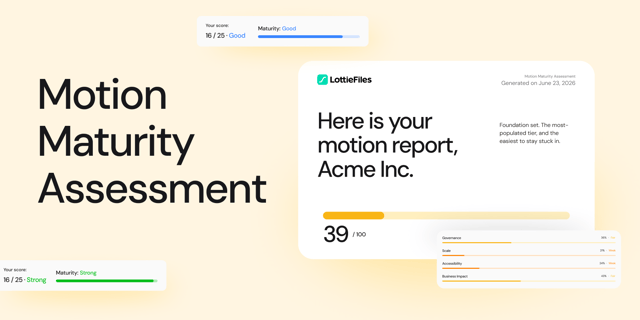
Motion Is the One Discipline You Can Feel but Can’t Measure
Motion maturity is simply how far your team has moved from doing motion as a series of one-offs toward running it as a system.

Best Motion Design Tools in 2026: Ranked by Use Case
The right motion design tool in 2026 is determined by one question: where does the animation live?
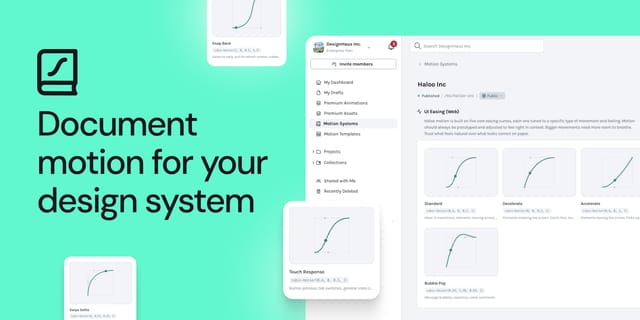
How to Document Motion in Your Design System: A Step-by-Step Guide
Here's how to actually document motion in your design system, step by step.
Create with Motion: The Complete Guide to Shipping Motion That Actually Scales
Every other layer of your product stack has been standardized. Color, typography, spacing, components. Motion hasn't. Here's how to fix that.