
Free Alpha decay – radium to radon - Question Animation
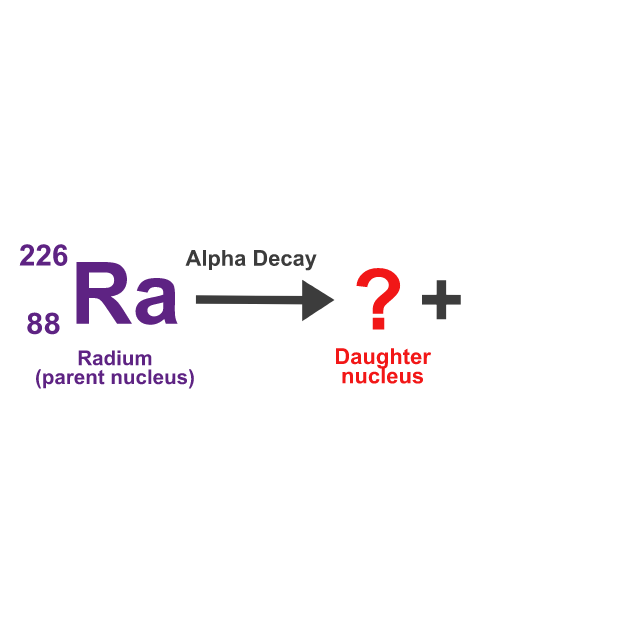
Alpha decay – radium to radon Nuclei of certain isotopes are known to be unstable. This is because they contain excess energy, and to become more stable they will release this energy through a process known as radioactive decay. One form of nuclear radiation that can occur is **alpha-radiation**. In this form of radiation the parent nucleus will release an alpha-particle and in doing so will decay to a different daughter nucleus. An example of an isotope that undergoes alpha-emission is Radium (\\(^{226}\_{88}\\)Ra). What daughter nucleus will \\(^{226}\_{88}\\)Ra decay into when it undergoes alpha-emission?
Alpha decay – radium to radon Nuclei of certain isotopes are known to be unstable. This is because they contain excess energy, and to become more stable they will release this energy through a process known as radioactive decay. One form of nuclear radiation that can occur is **alpha-radiation**. In this form of radiation the parent nucleus will release an alpha-particle and in doing so will decay to a different daughter nucleus. An example of an isotope that undergoes alpha-emission is Radium (\\(^{226}\_{88}\\)Ra). What daughter nucleus will \\(^{226}\_{88}\\)Ra decay into when it undergoes alpha-emission?
- Optimized dotLottieRecommended
Smallest file size with themes and interactivity.
- dotLottie22.2 KB
Compressed, supports theming and states.
- Optimized Lottie JSON98 KB
Optimized JSON for faster loading.
18% smaller than Lottie JSON - Lottie JSON120.2 KB
Standard Lottie format, broad compatibility.
Other export formats
Interactions & plugins
View all


Free to use under the Lottie Simple License